
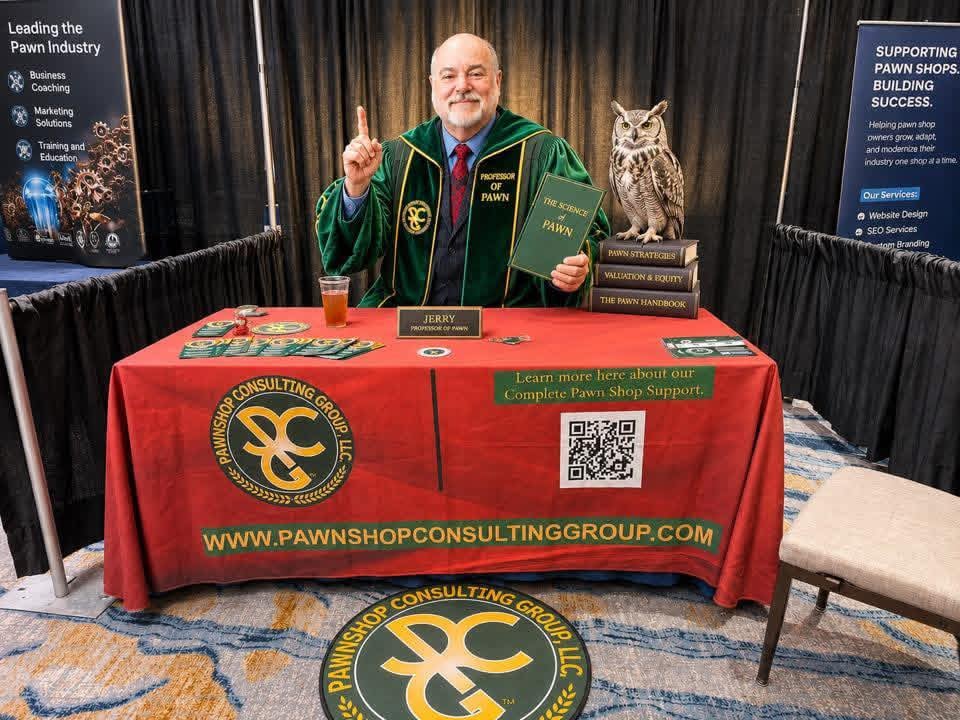
 Pawnshop Consulting Group Founder Jerry Whitehead
Pawn Shop Metrics and Key Performance Indicators on Steroids – How I got HERE
Pawnshop Consulting Group
Brief History on my Pawn Career and the various introductions to Financial Metrics of which I will be expanding on greatly at this years Pawn Expo in Las Vegas.
Jerry Whitehead will be speaking at the NPA and make it a point to come and hear and support one of the NPA vendors this year, Pawnshop Consulting Group as WE always be there!
2026 Conference Schedule – Pawn Expo
Pawn Expo Monday July 20th:
1:10 pm – 2:00 pm
Industry Insights: Pawn Shop Metrics and Key Performance Indicators on Steroids
Presented by: Pawnshop Consulting Group LLC
Speaker: Jerry Whitehead
This year at the NPA Pawn Expo in Vegas – PCG and self – Jerry Whitehead will be producing a “do not miss” opportunity to hear it from one of the industry’s longest standing PAWN specific consultants with a world-wide client base on what you should know about the Key Performance Indicators of PAWN, and the term “Financial Metrics on Steroids”
To substantiate my history in Pawn and how I came to be, enjoy the read!
I have spent a lifetime in the industry and was introduced to the most basic numbers and metrics back in the 60’s. My father had developed some very rudimentary ways to clock our stores, cash flow, and a basic set of KPI’s all calculated manually and long before computers or XL spreadsheets came along.
Our daily “sheet” if you will back in 1960’ sumthin’ and was an honorable attempt from pops!!
After becoming involved with growing our brand, computerizing them back in the late 80’s with some basic DOS (PPBS) Petticrew Pawnbroker System pawn software and more, a whole series of other’ levels of metrics understanding started to come into play for me.
This began to happen as I consumed the data points we could create and wanted to create within our own systems at those times and how to really pay attention to each store, each market, and how the overall financial health of the company was or would flow.
Anticipating cash flow needs and more, quite a necessity especially when opening some of the types of super stores we were at that time.
My brother Bobby Whitehead Jr.
Several years earlier, our family business, thanks to my brother Bobby Whitehead Jr, began looking at the possibility of taking our company public and presented the concept to my father. At that time, they explored a reverse merger into a public shell that posed many possibilities for achieving those goals way back when.
It should be denoted that Cash America and First Cash both went public out of our hometown of Ft. Worth Texas, and were later followed by EZ Corp out of Austin Texas.
Thanks to my brother, my father continued with his interest and perhaps his desire to take our company public.
In my case, I started attending all of the IPO classes and more that were being offered up by the big-6 accounting firms at the time in the DFW metroplex.
This was also coupled with attending various clinics offered up by various underwriters and institutional types, and I read everything I could from public filings on Cash America, First Cash, and EZ Corp to enhance my knowledge and skills on the subject matter.
AS public companies, all of their financial filings are publicly visible.
At one point, through one of my random ads in the Wall Street Journal we found and recruited the same attorney that was involved with taking Cash America public.
It should also be noted for historical reference, First Cash got publicly traded with 5 stores.
They raised 5 million on their IPO and they were off to the races.
First Cash initially reached out to me directly by John Payne who was one of the founders of First Cash and also served on the Texas Pawnbrokers Association board back then along with me. He and the other founder of First Cash, Rick Powell PhD., who was the interim CFO at that time wanted to meet with us “Uncle Joe’s Pawn”, and we did.
We did a dance with FC in those days, a whole bunch of due diligence work began between our parties and more and we were literally at a LOI, or letter of intent stage with them at one point.
Unfortunately, aside from the 1 million off the top offered to my father, the rest of that proposed transaction was an all-stock deal. That comes with restrictions, and my mother at the time wanted nothing to do with it. Our company was valued at 70% of the proposed combined entity at that time which is worthy of mention.
Today First Cash has a market cap of 9 Billon ++ with 3400++ stores on 3 continents.
By this time, I was deeply imbedded into the understanding of the financial performance anticipated by investors, underwriters, and the big-6 accounting groups and knew, “I needed to know this information”.
It was apparent back in those days, I was being groomed to be the front runner and or face of our organization, and as such that did terrify me at the time!
I knew I needed a deeper understanding of the financial lingo and more to be able to speak the language, and also understand it.
This would become more much apparent as I was being plunged into the financial community and more head first.
I was not formally educated as an accountant with a financial background as another note worthy of mention.
In the early days, as I began to comprehend the public company’s financial filings, I was amazed at some of their practices and how they could get away with it.
Most individuals would not understand the accounting principles and some of the lingo to put it mildly.
GAAP Accounting and the Pawn Industry
The big-6 accounting firms, particularly one of the biggest at that time, “Coopers & Lybrand” came up with some creative accounting for pawn under the term “GAAP accounting” or “Generally accepted accounting practices”
In those days, ALL of the public pawn companies accrued their pawn fees up front when they wrote the loans. Their thought processes were, if 80% of our loans are serviced, in theory we could book the “anticipated” pawn service charge fees up front as income at the moment they wrote the loan and it went right on their P&Ls as income at that moment.
If and when the loans defaulted, they added those accrued upfront fees into the cost of goods of those forfeited items.
It did vastly inflate their “PSC” or Pawn Service Charge income on the income statements.
Example, $100 loan written, $40 added as income at that moment.
$100 loan forfeits, they add $40 into the cost, illustrating cost of goods now $140 since they already booked the fees that were not collected into the cost of the item as a profit at the time of loan origination.
Over time, this came to haunt all of the public pawn companies.
Once Wall Street figured out, to me, it seemed like a grift, or what Wall Street commonly terms as “smoke and mirrors” and it was just that, an accounting illusion in my book.
The down side of this effect was, most all of their reported income for several years was all sitting in growth of inventory sitting on their shelves. Aging inventory became a huge problem, inventory yields sank faster than the Titanic, and margins, or sales profits began to rapidly diminish as the inventory value plummeted all at the same time.
How to solve the problem?
Revert back to a cash basis form of accounting, and collectively write off 100’s of millions in inventory between all (3) of these public companies back in the day.
In effect, a onetime “hit” on the balance sheet, big stock price hits, followed by improved sales margins, inventory yields, and stable cash flow. Problem solved right?
It should be noted in my case, at this time post the sale of our family company, I was deeply involved as the Chief Operating Officer of Doc’ Holliday’s’ out of Austin in attempting to get our company publicly traded as well.
When I joined the team right after selling out to Cash America, I grew the company through strategic alliance with many other multi-store operators I had met from years of board experience on various trade associations.
This proved advantageous and I began to convince, evaluate, and roll up a number of multi-store groups to join in with us for this anticipated IPO WE were working on with the Doc Holliday team.
Mergers and Acquisitions were heavy on my plate as the COO at the time, and applying various methodologies on how to valuate stores and acquiring them became a big play in my early years in the early 90’s with Doc Holliday’s.
We had 8 stores in the Austin area when I joined the team in January of 1993, by July of 1996, we had more than 50 stores operating in 6-states.
As such, there is where the advanced schooling came in my early days or larger multi-unit pawn operations in how to: operate them, account them, evaluate them, compare them, grow them, and talk the story’ to various analytical people from a wide arena of accounting firms, underwriters, and analysts.
We used to say, we had analysts crawling up every orifice we had!!
No truer words could have been said.
What we did discover as we were constantly comparing ourselves on per store, per square foot, revenue, net income metrics, and more on all of our stores to the other public companies for same data points available from their reported SEC filings and more the following:
By late 1996 we were out performing Cash America stores on a 2 to 1 basis on average, and EZ about a 60% edge in better performance on per store stats at that time.
It should also be noted that when the publics’ all wrote off their huge inventory mistakes, valuations for public companies, their stock prices, and our company valuation all plummeted at that time, and the season for rolling out public pawn companies officially closed for a long while.
Post the closing of our immediate opportunity for an IPO, It should be noted that Doc Holliday’s was acquired in late 1997 by Cash America.
AS a footnote to that event, much like the Uncle Joe’s deal I was involved in hand in hand with our family, Doc Holliday’s at time of acquisition with the general value and multiple ranges offered on the assets and business in general were at historic levels at that time as well.
It was much more beneficial for Cash America to offer a substantial multiple to “take out” Doc’s VS having to explain their lack of performance on same store performances had we gotten it publicly traded and ripped up the markets with outstanding store and corporate performance.
We did assemble an amazing team and were kickin’ it as well back then.
AS seen I have spent a lifetime in the Pawn Universe, and building, growing, and assessing all aspects of all of these projects were heavily predicated on the Financial Metrics!
Jerry Whitehead
Contact Information
Pawnshop Consulting Group, LLC.
Put PCG Experience to Work
Have a question about your pawn business, financial performance, people, valuation or next strategic move?
REQUEST A CONSULTATION