
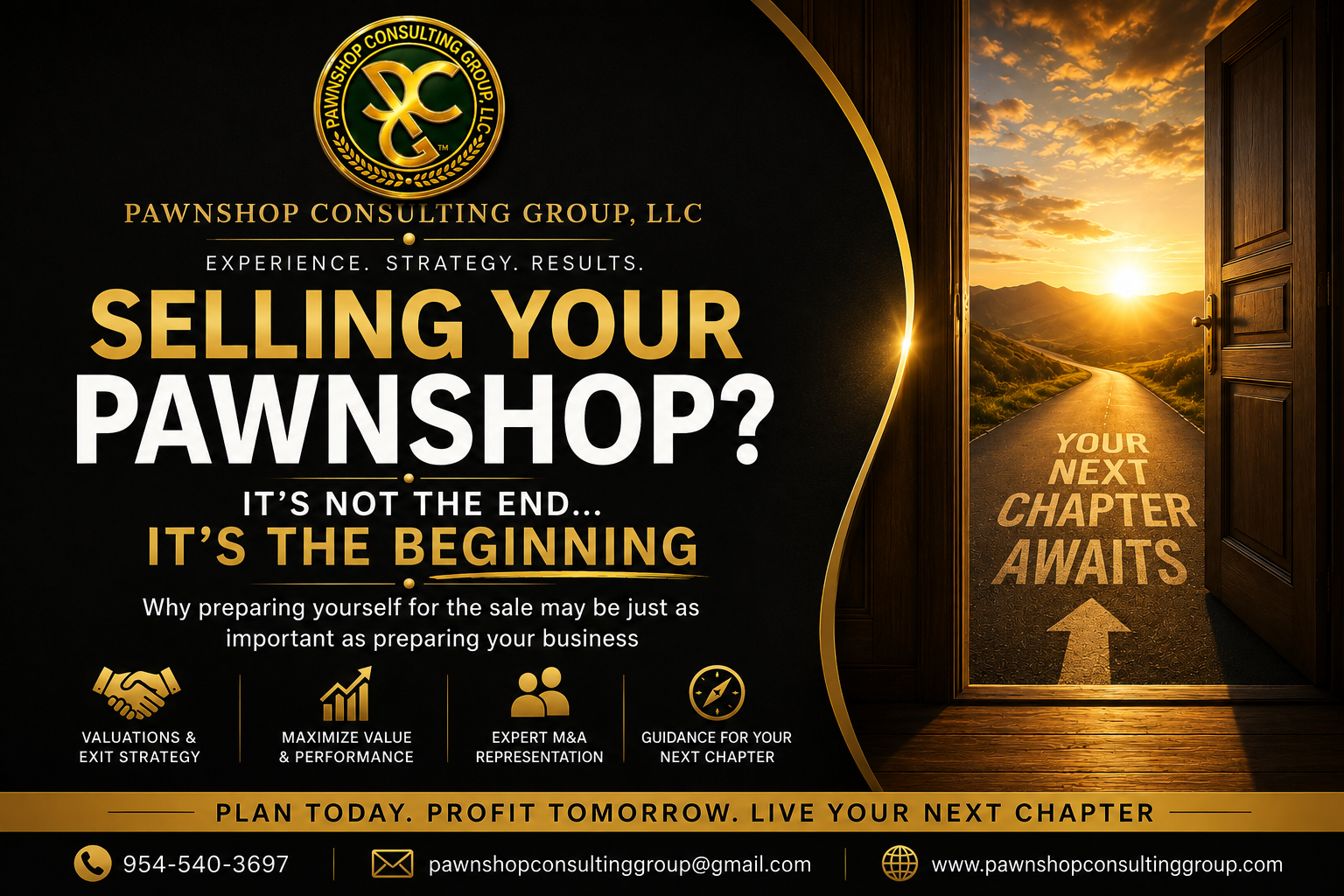
 Selling your pawnshop isn’t simply the end of a business. PCG helps pawnshop owners maximize value, prepare for a successful sale and plan their next chapter.
Selling Your Pawnshop Isn’t the End — It’s the Beginning of Your Next Chapter
Why preparing yourself for the sale may be just as important as preparing your pawnshop
For most successful pawnbrokers, selling a pawnshop is not simply another business transaction.
It may be the culmination of 20, 30, 40 or even 50 years of your life.
You didn’t just build a loan balance.
You built relationships.
You hired people, trained people, watched employees grow up, watched their children grow up, and in many cases watched your own children grow up inside the business.
You survived recessions, changing regulations, competitors, economic cycles, technology changes, robberies, employee problems, bad loans, great years, terrible years and everything else this industry can throw at an owner.
And then one day somebody hands you a check.
You hand them the keys.
Now what?
That may be one of the most important questions a pawnshop owner can answer before selling the business.
At Pawnshop Consulting Group, we spend a great deal of time helping owners understand what their businesses are worth, improving operating performance, preparing stores for sale, evaluating acquisition opportunities, negotiating transactions and helping owners maximize the value they have spent decades creating.
But there is another component to a successful exit that deserves considerably more attention:
Is the owner ready?
A Business Can Be Ready for Sale Before Its Owner Is Ready to Sell
I was recently reminded of this by an excellent case study published by the Exit Planning Institute (EPI) involving business executive and advisor Scott Couchenour.
Couchenour spent nearly three decades in his family’s business, including many years as COO and later CEO. The family company had operated for more than four decades.
Then circumstances changed dramatically.
After years of navigating the aftermath of the Great Recession, the company remained financially vulnerable. In 2015, the loss of an important project contributed to an unexpected closure of the business.
Couchenour has subsequently spoken openly about what happened next.
The loss wasn’t merely financial.
He lost his career, his daily routine and, perhaps most importantly, a large part of the identity that had become connected to the business.
He eventually transformed that experience into another career helping business owners prepare themselves for life after ownership.
His experience struck a chord with me because I have seen versions of this throughout my career in the pawn industry.
And I’ve lived some of it myself.
I’ve Handed Over the Keys, Too
My perspective on selling a pawnshop doesn’t come exclusively from sitting on the consulting side of a conference table.
I’ve been on the ownership side of that table.
I grew up in the pawn business. My family built pawnshops. I managed them. We expanded them. I participated in acquisitions, dispositions and major transactions involving operating companies that represented years of people’s lives.
I’ve watched businesses change hands that owners spent decades building.
I’ve also personally experienced what happens when one chapter of a business career closes and another begins.
Eventually, the experiences accumulated over a lifetime in pawn became part of the foundation for what I do today through Pawnshop Consulting Group.
That’s one reason I believe there is a question every owner contemplating a sale needs to answer:
What are you retiring TO?
Not merely:
What are you retiring FROM?
There is an enormous difference.
Your Walk-Away Number Is Only Half the Equation
Most owners considering a sale eventually arrive at a number.
“If I can walk away with $X, I’m done.”
That’s important.
You should know what your business is worth.
You should understand normalized earnings.
You should understand your loan portfolio, inventory, real estate, leases, tax implications and transaction structure.
You should know what the market is paying.
And you certainly should have experienced representation protecting your interests when negotiating with sophisticated buyers.
But none of those things answers this:
What are you going to do Monday morning after the transaction closes?
That leads me to something I believe every owner contemplating an exit should remember:
Your walk-away number tells you what you need to leave the business. Your life plan tells you what you’re leaving the business for.
— Jerry Whitehead
Those are two entirely different calculations.
And both matter.
The Three Components of a Successful Pawnshop Exit
When PCG talks with an owner contemplating a transaction, I believe there are really three different kinds of readiness that should be considered.
1. Is Your Business Ready?
This is where most traditional exit preparation begins.
Is the business actually positioned to command its highest reasonable market value?
A prospective buyer isn’t purchasing your memories.
They’re purchasing future economic performance.
That means examining issues such as:
- Sustainable earnings
- Loan balance and loan growth
- Pawn service charge and interest income
- Inventory quality and aging
- Inventory turns
- Gross margins
- Labor productivity
- Expense structure
- Store-level profitability
- Management depth
- Regulatory compliance
- Lease terms
- Market demographics
- Competitive position
- Customer concentration
- Owner dependence
- Quality and consistency of financial records
One of the most common mistakes I see is an owner deciding to sell before preparing the company to be sold.
Sometimes another 12, 18 or 24 months of disciplined operational improvement can materially change the economics of a transaction.
That is why exit planning should ideally begin long before somebody puts a purchase agreement on the table.
2. Are You Financially Ready?
This question sounds obvious, but it goes much deeper than the selling price.
A $5 million offer is not necessarily a $5 million retirement.
Transaction expenses, taxes, debt, reinvestment requirements, lifestyle expectations and future income needs all matter.
Owners also need to understand the difference between business value and personal financial independence.
Those are not automatically the same thing.
An owner should be working with appropriate financial, tax, estate and legal professionals well before closing.
PCG’s role is not to replace those advisors.
Our role is to make sure the pawn-business side of the equation is properly understood and represented—and to work collaboratively with the owner’s professional advisory team when appropriate.
3. Are YOU Ready?
This may be the question nobody asks.
For decades, somebody may have known you as:
“Jerry from the pawnshop.”
“Mike from ABC Pawn.”
“The owner.”
“The boss.”
Every morning there was somewhere to go.
There were problems waiting to be solved.
Employees needed decisions.
Customers knew you.
Vendors called you.
Your phone rang.
You were needed.
Then you sell the company.
The money reaches the bank.
Everybody congratulates you.
And suddenly nobody needs you at the store tomorrow morning.
For some owners, that’s freedom.
For others, it can create a vacuum they never anticipated.
The Exit Planning Institute’s work around personal planning highlights precisely this issue: preparing the company financially and operationally does not necessarily mean the human being who owns it is prepared for the transition.
Your Business Is Something You Built. It Isn’t Everything You Are.
This distinction can be difficult for entrepreneurs.
Pawnshop owners are particularly susceptible because pawn is such an owner-driven business.
Many of us didn’t work at the business.
We lived it.
The store was part of the family.
Vacations got interrupted.
Weekends disappeared.
Dinner conversations became business meetings.
Children worked summers in the stores.
Spouses kept books.
Family members opened additional locations.
Employees became lifelong friends.
Customers became multigenerational relationships.
After enough decades, separating the owner from the company becomes difficult.
That is why a successful transition requires more than removing your name from a license.
You have to begin envisioning an identity that isn’t dependent upon possessing the keys to the front door.
Don’t Wait Until Closing Day to Figure It Out
One of the most useful lessons from Couchenour’s experience is that personal transition planning should occur before the exit.
His business closure was involuntary, which made the consequences substantially more difficult. Today, his work focuses on helping owners create purpose and structure for what comes afterward. EPI describes the objective as helping owners view an exit as something they’re moving toward, rather than simply something they’re escaping.
That is excellent advice for pawnbrokers.
If you’re fortunate enough to control the timing of your exit, use that advantage.
Ask yourself:
What do I want the next 10 or 20 years to look like?
Maybe you want to travel.
Maybe you want to spend time with grandchildren.
Maybe you want to invest.
Maybe you want to mentor younger pawnbrokers.
Maybe you want to remain involved in the industry without carrying the responsibilities of ownership.
Maybe you want to serve your community.
Maybe you want to teach.
Maybe you want to buy another company.
And maybe you don’t want to retire at all.
That’s perfectly legitimate, too.
Selling a pawnshop and retiring are not synonymous.
Sometimes Selling the Business Creates the Next Opportunity
I’ve learned this firsthand.
The accumulated knowledge from decades of building, operating, buying, selling, evaluating and advising pawn businesses didn’t disappear when individual businesses changed hands.
It became intellectual capital.
Experience has value.
Relationships have value.
Judgment has value.
The lessons from mistakes have tremendous value.
In many respects, the next chapter can become an opportunity to deploy everything you’ve learned without carrying all of the responsibilities you carried previously.
Couchenour now describes an exit as a “launchpad” rather than merely an ending. His own unexpected transition ultimately became the foundation for helping other business owners navigate theirs.
I think that’s a powerful concept.
Especially for pawnbrokers.
What Will Your Next Chapter Look Like?
Imagine that your transaction closes Friday afternoon.
The wire transfer arrives.
Documents are signed.
Keys are transferred.
Employees have been informed.
For the first time in 30 years, you don’t own a pawnshop.
What happens Monday?
Where do you go?
Who calls you?
What excites you?
What challenges you?
What gives you purpose?
What are you building now?
If those questions are difficult to answer, that doesn’t necessarily mean you aren’t ready to sell.
It may simply mean your exit planning isn’t finished.
PCG’s Advice: Start Planning Before You Want Out
If you’re 55 and believe you might want to sell at 60, don’t wait until you’re 59½ to start thinking about it.
Those five years can be enormously valuable.
They give you time to improve earnings.
Grow loan balances.
Clean up aged inventory.
Develop management.
Reduce owner dependence.
Improve financial reporting.
Correct compliance weaknesses.
Secure better leases.
Document operating procedures.
Explore potential buyers.
Structure your personal financial plan.
And equally important:
Figure out what comes next.
A well-planned exit shouldn’t feel like you’re walking away from your life’s work.
It should feel like you’ve successfully completed one chapter and earned the right to begin another.
Selling Your Pawnshop Should Be a Beginning, Not Just an Ending
The pawnshop you built may represent one of the greatest accomplishments of your life.
Treating its sale merely as a financial transaction doesn’t give that accomplishment—or you—the consideration it deserves.
Prepare the company.
Prepare the finances.
Prepare the transaction.
And prepare yourself.
Because eventually the purchase agreement gets signed.
Eventually the money changes hands.
Eventually somebody else unlocks the front door.
And then comes the part of exit planning we don’t talk about nearly enough:
What are you going to do with the freedom you’ve spent your entire career earning?
At Pawnshop Consulting Group, we believe the objective shouldn’t simply be to help an owner get out.
It should be to help that owner get somewhere worth going.
Considering Selling Your Pawnshop?
Whether your timeline is six months or five years, knowing where you stand today is the place to begin.
Pawnshop Consulting Group assists pawnshop owners with:
Pawnshop Valuations • Exit Readiness • M&A Representation • Acquisition Strategy • Operational Improvement • Financial & KPI Analysis • Buyer/Seller Representation • Transaction Preparation
If you’re contemplating selling your pawnshop—or simply want to understand what your business may be worth and what could increase that value before an eventual sale—contact Pawnshop Consulting Group, LLC for a confidential discussion.
954-540-3697
pawnshopconsultinggroup@gmail.com
www.pawnshopconsultinggroup.com
Your exit shouldn’t begin when someone makes you an offer. It should begin when you decide what you want the next chapter of your life to look like.
Source & Inspiration
This article was inspired in part by the Exit Planning Institute’s case study and educational materials concerning Scott Couchenour’s experience following the unexpected closure of his family’s business and his subsequent work in personal exit planning. EPI’s materials emphasize the importance of aligning business, financial and personal planning when preparing an owner for transition.
Put PCG Experience to Work
Have a question about your pawn business, financial performance, people, valuation or next strategic move?
REQUEST A CONSULTATION