
Clean Books – Better Information – Better Business Decisions
Pawn shop bookkeeping and accounting should provide owners with accurate, timely financial information they can understand and use to manage the business.
Pawn shop bookkeeping and accounting requires an understanding of more than debits, credits and bank statements. Pawn businesses generate financial activity through loans, service charges, merchandise purchases, inventory sales, forfeitures, layaways, cash transactions and other activities that must ultimately reconcile with the company’s accounting records.
Pawnshop Consulting Group helps pawnshop owners develop bookkeeping and financial-reporting systems that connect what is happening inside the pawn-management system with what appears on the profit-and-loss statement and balance sheet.
The objective is not simply to produce financial statements for the accountant at year-end.
The objective is to create timely, accurate and understandable financial information that ownership can actually use to manage the business.
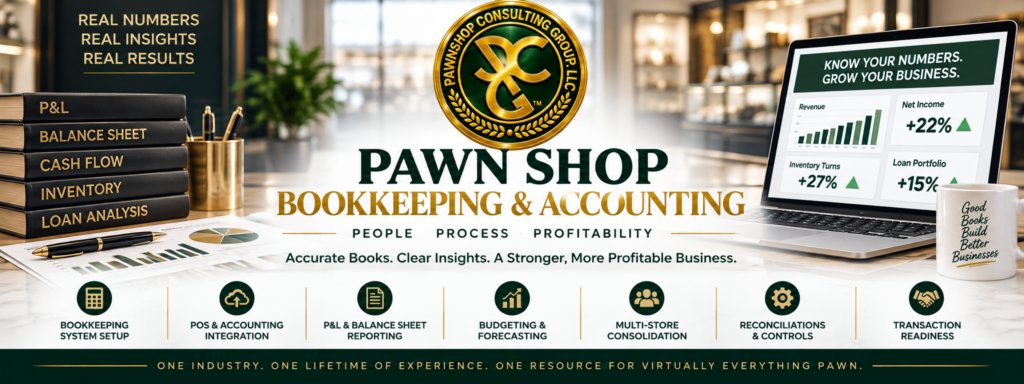
Pawn Accounting Is Different
A pawnshop is not a conventional retail business.
Capital moves continually between cash, pawn loans and inventory. Merchandise may enter the business through purchases or loan defaults. Revenue can come from retail sales, pawn service charges and other permitted activities. Individual stores may also operate with substantial daily cash movement.
Those characteristics can create bookkeeping challenges when the accounting system is not properly structured around the pawn operation.
A bookkeeper who understands traditional retail accounting but does not understand pawn may see numbers without understanding the transactions that created them.
PCG helps bridge that gap between pawn operations and financial accounting.
Connecting the Pawn System to the General Ledger
The pawn-management system and the accounting system serve different purposes, but their information must ultimately make financial sense together.
Pawn software may track loans, redemptions, renewals, forfeitures, inventory, sales, purchases, layaways and other store activity.
The accounting system must convert that operating activity into properly classified financial information.
PCG can assist with the relationship between pawn-system reporting and accounting platforms, including account mapping and month-end reporting procedures.
Depending upon the systems being used, this may involve direct integrations, exported reports, journal-entry procedures or carefully structured reconciliation processes.
The objective is consistency, accuracy and repeatability.
Chart of Accounts & Account Mapping
A useful financial-reporting system begins with a chart of accounts designed to provide meaningful information.
If accounts are too broad, ownership may not have enough detail to understand performance.
If they are unnecessarily complicated, bookkeeping becomes difficult and financial statements become harder to interpret.
PCG can assist clients in evaluating account structures and mapping operating activity into appropriate financial categories.
That may include revenue classifications, payroll, operating expenses, pawn loans, inventory, cash accounts, liabilities, owner-related activity and other accounts necessary to produce useful financial statements.
The chart of accounts should support both accurate bookkeeping and practical management analysis.
Profit & Loss Statements
The profit-and-loss statement should tell ownership considerably more than whether the company made money.
A properly structured P&L can help management understand revenue sources, gross profit, payroll, operating expenses and profitability.
PCG can review P&L statements for consistency, classification issues, unusual activity and management-reporting opportunities.
We can also compare results across months, years, stores and established budgets to identify trends that may require management attention.
Financial statements become substantially more valuable when they are used as management tools rather than historical documents.
Balance Sheets Matter
Owners frequently focus heavily on the P&L while paying less attention to the balance sheet.
That can be a mistake.
The balance sheet provides important information about cash, pawn loans, inventory, liabilities, debt, equity and the overall financial position of the business.
Changes in loan balances and inventory can consume substantial amounts of cash even while the P&L reports a profit.
PCG evaluates the relationship between the balance sheet and operating activity to help ownership understand where capital is being deployed and how the financial position of the business is changing over time.
Cash & Bank Reconciliation
Pawnshops can be cash-intensive businesses.
That makes disciplined reconciliation particularly important.
Bank accounts, deposits, withdrawals, checks, electronic payments and store-level cash activity should be reconciled consistently and supported by appropriate documentation.
Differences should be investigated rather than allowed to accumulate from one month to the next.
Reliable reconciliation procedures strengthen financial accuracy and can also improve internal controls.
Loan & Inventory Reconciliation
Pawn loans and inventory represent substantial assets in most pawn operations.
Financial reporting should therefore be evaluated against the operating information generated by the pawn system.
PCG can help clients compare loan and inventory information across operating reports and accounting records to identify inconsistencies that require investigation.
The purpose is not to force two fundamentally different reporting systems to produce identical reports.
The purpose is to understand legitimate differences, identify unexplained differences and maintain confidence in the financial information being used by ownership.
Month-End Close & Management Reporting
Financial information loses much of its management value when it arrives months after the activity occurred.
A disciplined month-end process can help ownership receive financial statements and management reports on a consistent schedule.
Depending upon the operation, the month-end process may include:
- Bank reconciliation
- Cash-account review
- Credit-card and payment-account reconciliation
- Loan-balance review
- Inventory review
- Accounts payable and accrued expenses
- Payroll reconciliation
- Revenue classification
- Balance-sheet review
- P&L review
- Store-level reporting
- Management KPI reporting
The objective is to create a repeatable financial close that produces timely information management can trust.
Multi-Store Financial Reporting
Multi-store organizations require both consolidated information and meaningful store-level reporting.
A company may be profitable overall while individual locations produce substantially different results.
PCG can help ownership structure financial reporting that allows management to examine the company as a whole while also evaluating individual stores.
That can support comparisons involving revenue, payroll, operating expenses, profitability, loan growth, inventory productivity and other key measurements.
The objective is visibility.
Ownership should understand where financial performance is being created and where additional management attention may be required.
Bookkeeping Should Support Financial Analysis
Accurate bookkeeping is the foundation. Financial analysis is what allows ownership to use that information.
Once financial statements are reliable and timely, PCG can help clients evaluate key performance indicators, historical trends, budgets, forecasts, cash flow and store-level performance.
The accounting system should therefore be designed not only to satisfy reporting requirements but also to support better business management.
Clean books create better information.
Better information creates better decisions.
Budgets, Forecasting & Planning
Historical bookkeeping tells ownership what has already happened.
Once that historical information is reliable, it can become the foundation for budgets and forecasts.
PCG can assist clients in developing financial models that establish expectations for revenue, gross profit, payroll, operating expenses, loan growth, inventory investment, cash flow and profitability.
Actual performance can then be compared with those expectations throughout the year.
This turns bookkeeping from a historical requirement into part of the company’s forward-looking management process.
Preparing for Valuation, Financing or a Transaction
Clean financial records become particularly important when ownership is considering a valuation, financing, acquisition, ownership transition or sale of the business.
Buyers, lenders, investors and advisors may require historical P&Ls, balance sheets, tax returns, operating reports and supporting financial information.
Inconsistent classifications, unexplained balances or incomplete records can create unnecessary questions and delay a transaction.
PCG can help ownership identify financial-reporting issues before they become transaction problems and assist in developing normalized financial information where appropriate.
Working With Your CPA & Tax Professionals
Accurate books and organized records also help support sound financial reporting and tax preparation.
PCG bookkeeping and financial-reporting support is designed to complement — not replace — the work of qualified CPAs, tax professionals and legal advisors.
Good bookkeeping can make the work of those professionals considerably more efficient by providing organized, reconciled and understandable financial records.
PCG can also help translate pawn operating activity into information that outside accounting professionals can more readily understand.
Tax positions, tax filings, audits and professional accounting opinions should be handled by appropriately qualified professionals.
Our role is to help make sure the underlying business information is organized and useful.
What PCG Can Help You Build
Pawnshop Consulting Group can work with ownership, internal bookkeeping personnel or outside bookkeeping professionals to strengthen the financial-reporting process.
Depending upon the engagement, assistance may include:
- Bookkeeping-system review
- Chart-of-accounts evaluation
- Pawn-system-to-accounting mapping
- QuickBooks setup and reporting structure
- Month-end close procedures
- Bank and cash reconciliation processes
- Loan and inventory reconciliation review
- P&L and balance-sheet review
- Store-level financial reporting
- Multi-store consolidated reporting
- Historical financial cleanup and organization
- Management reporting
- KPI integration
- Budgeting and forecasting support
- Financial preparation for valuation or M&A
- Coordination with CPAs and tax professionals
Financial Clarity Creates Management Control
Effective pawn shop bookkeeping and accounting creates the financial foundation for stronger controls, better analysis and more informed management decisions.
Ownership should not have to wait until tax season to understand how the business is performing.
Reliable financial reporting should provide management with an ongoing view of revenue, expenses, assets, liabilities, cash flow and profitability.
Effective pawn shop bookkeeping and accounting creates the financial foundation necessary for better operating decisions, stronger internal controls, meaningful forecasting and long-term strategic planning.
Clean Books – Better Information – Better Business Decisions
Start the Conversation
If your financial statements are arriving late, do not reconcile cleanly with store activity, lack meaningful store-level detail or simply are not providing the information you need to manage the business, PCG can help.
Tell us which pawn-management and accounting systems you currently use, how your bookkeeping is being handled and where you believe the reporting problems or opportunities exist.
PCG can help you evaluate the process and develop a more reliable financial-reporting structure for your pawn business.
Clean Books – Better Information – Better Business Decisions