
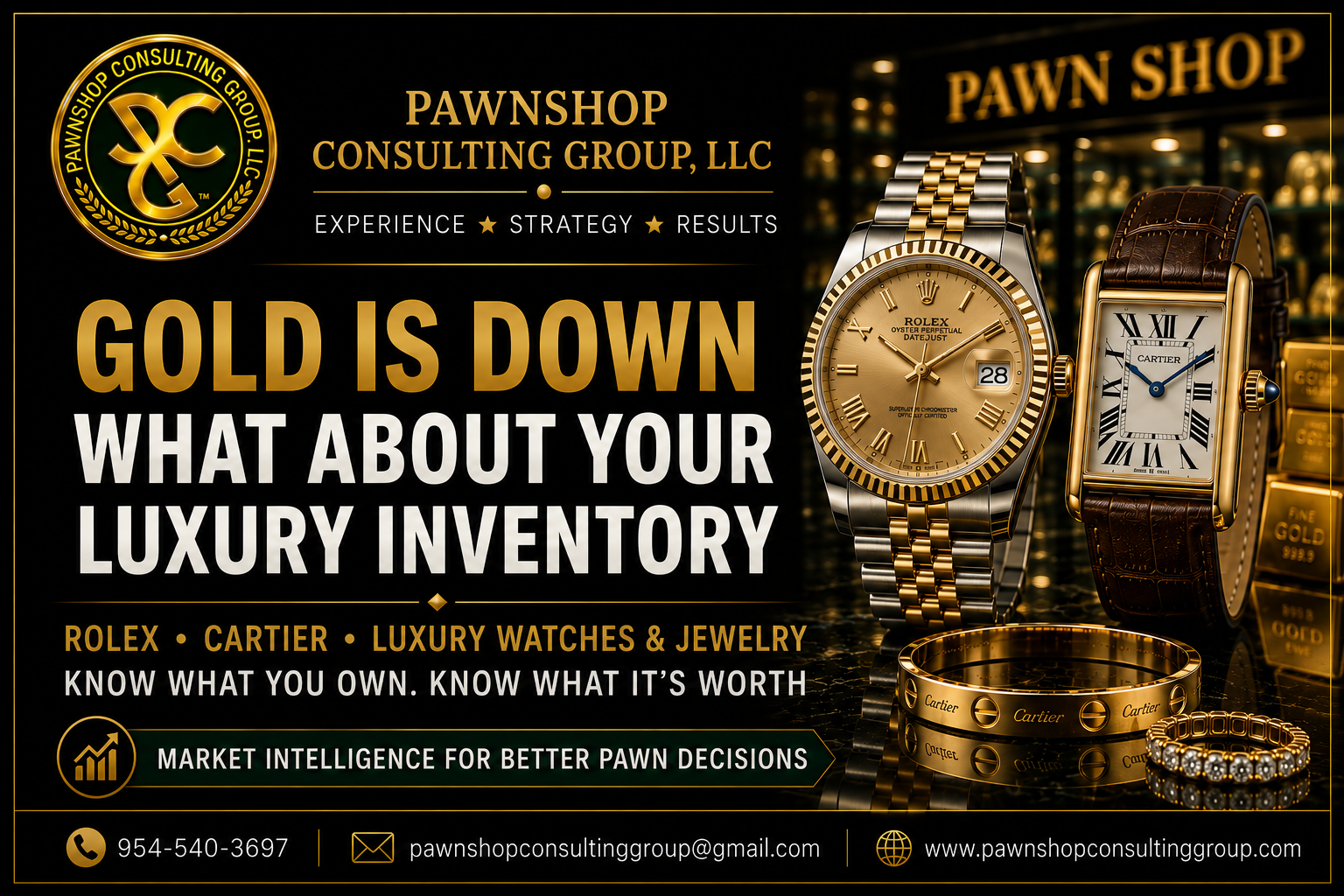
 Gold may be down from its 2026 peak, but luxury merchandise doesn’t necessarily follow the metal. PCG looks at Rolex, Cartier and what changing secondary-market values mean for pawnbrokers.
Gold Is Down. Are Your Luxury Watches Worth More Than You Think?
Why Rolex, Cartier and the Luxury Secondary Market Should Have Every Pawnbroker’s Attention
For generations, gold has been one of the foundations of the pawn industry.
We understand it.
We weigh it. Test it. Price it. Loan on it. Buy it. Sell it. Refine it.
When gold moves, pawnbrokers pay attention.
But here’s something else worth paying attention to in 2026:
Gold has retreated substantially from its January record—while portions of the luxury watch market are demonstrating that the value of a great piece can have surprisingly little to do with the value of the precious metal contained in it.
That distinction matters.
And for pawnbrokers dealing in Rolex, Cartier and other high-end watches and jewelry, it can represent real money.
Gold Came Down. Luxury Didn’t Necessarily Follow It.
Gold reached extraordinary levels early in 2026.
After hitting record territory in January, the metal subsequently experienced a substantial correction. Yet luxury brands didn’t simply reverse their pricing because the underlying commodity became cheaper.
In fact, the opposite has happened in several important areas.
Rolex increased prices at the beginning of 2026 and subsequently increased pricing on gold watches again in June. Cartier also raised prices during the year.
Meanwhile, portions of the secondary market have remained remarkably resilient.
That tells pawnbrokers something important:
The value of a luxury watch isn’t simply the sum of its materials.
A Rolex isn’t merely steel and gold.
A Cartier isn’t merely gold and diamonds.
There is another asset embedded in the piece:
The brand.
And sometimes that brand equity, scarcity, desirability and secondary-market demand can matter considerably more than the intrinsic value of the materials.
Pawnbrokers Need to Think Beyond Melt
There is an old-school valuation mentality that can become expensive when applied indiscriminately to luxury merchandise.
What’s the gold worth?
That’s certainly one component of value.
But with the right piece, it may be nowhere near the whole story.
Take a desirable Rolex.
Its market value can be influenced by:
- Exact reference number
- Model and configuration
- Dial
- Bezel
- Bracelet
- Production period
- Condition
- Service history
- Original box and papers
- Whether components are original
- Current availability
- Collector demand
- Retail pricing
- Secondary-market transaction activity
Two watches containing similar amounts of precious metal can have dramatically different market values.
That isn’t a precious-metals equation.
It’s a merchandise equation.
And good pawnbrokers need to understand both.
Cartier Deserves Particular Attention
One of the more interesting developments in today’s luxury market is Cartier.
Cartier has historically occupied an unusual position because it crosses several categories simultaneously:
Fine jewelry. Luxury watches. Fashion. Heritage. Collectibility. Brand recognition.
Recent secondary-market data indicate strengthening interest in Cartier watches.
Chrono24’s ChronoPulse data, for example, has shown particularly strong momentum around Cartier relative to other tracked luxury watch brands.
For a pawn operator, that means yesterday’s assumptions about a Cartier piece may not accurately represent today’s market.
And this is precisely why regular repricing and market research matter.
The item sitting in your showcase isn’t aware of what you paid for it.
The consumer isn’t particularly interested either.
The question is:
What is the piece worth in today’s market?
Rolex Remains a Market of Markets
Rolex deserves a little more nuance.
It’s tempting to talk about “the Rolex market” as though every Rolex moves in the same direction.
They don’t.
Different references, metals, configurations and generations can perform very differently.
Some Rolex secondary-market indexes have demonstrated meaningful year-over-year appreciation. Other broader measurements have shown softness.
That’s an important distinction.
Rolex isn’t one market.
A Datejust isn’t a Daytona.
A Day-Date isn’t a Submariner.
A current-production reference isn’t necessarily comparable to a discontinued reference.
Steel doesn’t necessarily behave like precious metal.
An ordinary configuration doesn’t necessarily behave like an unusual dial.
This is precisely why knowledgeable luxury-watch evaluation can create an advantage for a pawnshop.
The Pawnshop Opportunity: Know What You Own
Here’s where I believe this becomes particularly relevant to our industry.
Pawnbrokers regularly have substantial amounts of capital sitting in showcases.
Some of that merchandise may have been acquired months—or years—ago.
When was the last time somebody actually researched its current market value?
Not the original cost.
Not the amount loaned.
Not the price written on the tag.
Today’s market value.
If you have Rolex, Cartier, Patek Philippe, Audemars Piguet, Omega and other important luxury brands in inventory, somebody in your organization should periodically be examining current secondary-market conditions.
Markets change.
Models become fashionable.
Models fall out of favor.
Retail prices increase.
Discontinued references become desirable.
Certain dials attract premiums.
Collector tastes change.
And occasionally something you’ve owned for two years becomes worth considerably more—or less—than you think.
Reprice Your Showcases, Not Just Your Gold
Pawnbrokers are usually very good at repricing precious metals.
Gold moves $100 and everybody notices.
But when did you last reprice your high-end watch inventory?
That’s a question worth asking.
If a luxury watch has been sitting in inventory for an extended period, don’t automatically assume the answer is another markdown.
Research it first.
The underlying market may have moved.
That doesn’t mean every watch should be marked up.
Far from it.
It means the decision should be based on current market intelligence rather than inventory age alone.
That’s an important distinction.
Buying and Lending Opportunities Matter Too
The same principle applies across the counter.
A customer walks into your pawnshop with a luxury watch.
If your employee sees only:
“Gold watch.”
you may have a problem.
The trained employee should be asking:
What brand?
What reference?
What configuration?
Is it authentic?
Is it complete?
What is the condition?
What are comparable pieces actually trading for?
How liquid is this particular reference?
What can we realistically sell it for?
Only then can you begin making an intelligent loan or purchase decision.
Knowledge allows you to potentially make a stronger offer while still protecting your margin.
And stronger offers can win better merchandise.
Authentication Has Never Been More Important
There is another side to this opportunity.
Higher values attract better counterfeits.
The sophistication of counterfeit luxury watches and jewelry has increased tremendously.
A high-end piece should never receive a high-end valuation simply because somebody recognizes the logo.
Authentication procedures need to evolve alongside merchandise values.
That can include:
- Employee education
- Reference research
- Movement inspection where appropriate
- Serial and model verification
- Professional authentication resources
- Digital market-comparison tools
- Documentation review
- Establishing relationships with qualified watchmakers and specialists
The more you’re willing to loan, the more certain you need to be about what you’re holding.
Margin Is Made When You Buy
I’ve said variations of this throughout my career:
Your opportunity for profit begins at the counter.
If you don’t understand what you’re buying, you can’t intelligently establish your investment.
If you underestimate a piece, you may lose it to a competitor.
If you overestimate it, you may own it for a very long time.
If you value it merely for its gold content, you may completely misunderstand what walked through your door.
Knowledge creates confidence.
Confidence creates better buying decisions.
And better buying decisions create margin.
Luxury Consumers Don’t Behave Exactly Like Commodity Buyers
There’s another lesson in the current market.
Luxury goods have characteristics commodities don’t.
Gold has a quoted market price.
A Rolex has a market and a story.
So does Cartier.
Luxury buyers respond to scarcity, status, craftsmanship, history, fashion, availability and brand prestige.
Economists sometimes describe certain luxury products as Veblen goods—products for which high price and exclusivity can actually contribute to desirability.
That helps explain why a decline in the underlying commodity doesn’t automatically translate into an equivalent decline in the finished luxury product.
For pawnbrokers, this means we need to distinguish between:
Intrinsic value
and
Market value.
They aren’t always remotely the same thing.
The Broader Lesson for Pawn: Information Creates Value
This isn’t really just a story about gold.
And it isn’t only a story about Rolex or Cartier.
It’s about understanding merchandise.
The best operators in our industry know that information is one of the most valuable assets behind the counter.
Whether we’re talking about:
- Luxury watches
- Diamonds
- Designer jewelry
- Coins
- Firearms
- Musical instruments
- Collectibles
- Electronics
- Tools
the operator with better information has an advantage.
Today, that information is more accessible than at any point in the history of our industry.
There is very little excuse for valuing an important piece based solely on what somebody remembers it being worth three years ago.
PCG’s Recommendation: Take Another Look at Your Luxury Inventory
If your stores carry meaningful amounts of high-end watches and jewelry, this is an excellent time for a review.
Pull the aged inventory report.
Identify your higher-dollar luxury pieces.
Research them individually.
Compare current secondary-market pricing.
Review your retail prices.
Review your cost basis.
Look at how long each piece has been in inventory.
Determine whether your employees understand how to properly evaluate these items when they come across the counter.
And don’t assume an aged item automatically needs another discount.
You may be surprised by what you actually own.
The gold market will continue moving.
Luxury markets will continue moving.
Consumer preferences will continue changing.
Our job as professional pawnbrokers is to keep moving with them.
Because sometimes the greatest opportunity isn’t acquiring another piece of inventory.
It’s recognizing the value already sitting in your showcase.
Pawnshop Consulting Group
Pawnshop Consulting Group works with pawn operators throughout the United States and internationally to improve inventory performance, merchandise turns, margins, buying and lending practices, financial performance and overall store operations.
If your operation needs assistance evaluating inventory performance, developing stronger merchandise strategies, training employees or identifying opportunities hidden inside your existing business, contact PCG.
954-540-3697
pawnshopconsultinggroup@gmail.com
www.pawnshopconsultinggroup.com
Better information. Better decisions. Better pawn businesses.
Market Source Note
This commentary was inspired by recent reporting from Crown & Caliber concerning the divergence between 2026 gold prices and portions of the luxury-watch market. PCG independently reviewed additional current market reporting and secondary-market data in developing this pawn-industry perspective.
Put PCG Experience to Work
Have a question about your pawn business, financial performance, people, valuation or next strategic move?
REQUEST A CONSULTATION