
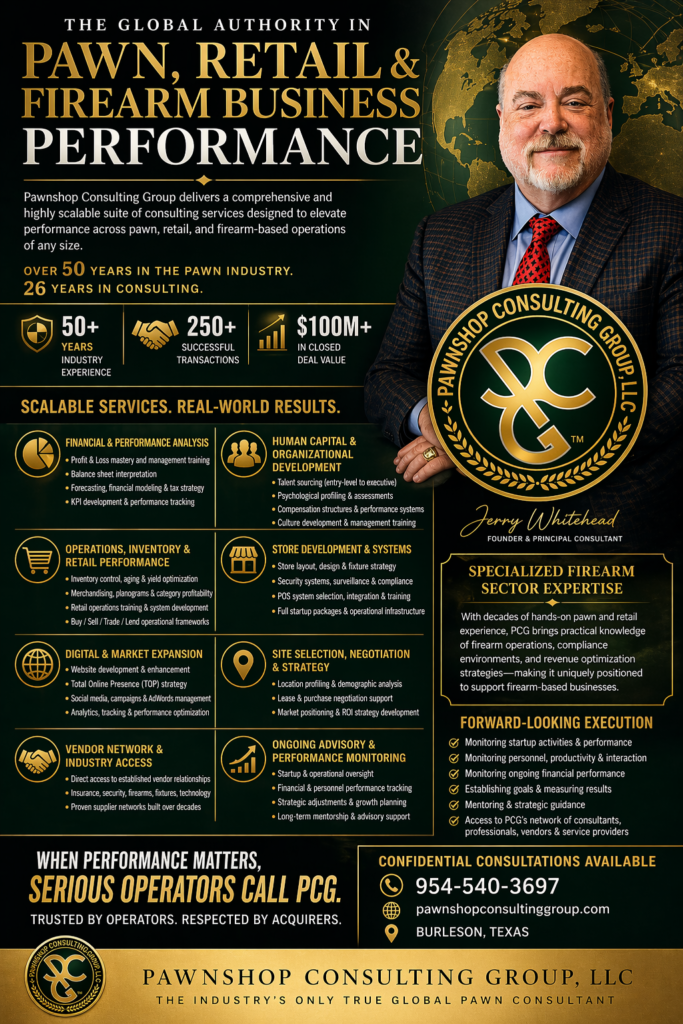
 Pawnshop Consulting Group Suite of Service
Pawn Shop Business Management: 14 Questions Every Owner Should Ask
Stronger Pawn Businesses Start With Better Questions
Running a pawn business can make it difficult to see the operation objectively.
Owners and managers spend every day solving problems, serving customers, managing employees, making loans, moving inventory and dealing with the unexpected.
Sometimes the most valuable management exercise is simply to stop and ask:
Where are we performing well—and where are we leaving opportunity on the table?
Pawnshop Consulting Group works with pawn operators around the world to evaluate financial performance, operations, people, inventory, customer experience and long-term strategy.
The following 14 questions provide a practical starting point for evaluating your own pawn business.
1. Are You Recruiting the Right People?
Hiring isn’t simply about filling an empty position.
The right employee needs the skills, attitude, reliability and ability to perform within your particular organization.
Ask yourself:
- Do we clearly define each position?
- Do we know what a successful candidate looks like?
- Are we recruiting proactively or only when someone quits?
- Are managers consistently hiring people who improve the organization?
Weak recruiting eventually becomes an operational problem.
2. Are You Keeping Your Best Employees?
Recruiting good people is expensive.
Losing good people can be even more expensive.
Look at employee turnover, compensation, management quality, advancement opportunities, scheduling, training and workplace culture.
If your strongest employees regularly leave, management should understand why.
Retention problems are often symptoms of larger organizational issues.
3. Does Your Compensation System Reward the Results You Actually Want?
Compensation influences behavior.
If employees are rewarded for one activity while ownership needs another result, the compensation system may unintentionally work against the business.
A strong productivity and compensation program should connect employee opportunity with measurable business performance.
That can include loan production, retail activity, gross profit, productivity, customer service and overall store performance.
Pay should reinforce the behaviors that build the business.
4. Do Your Managers Know Exactly What They Are Accountable For?
A title doesn’t create accountability.
Managers need clear expectations and objective measures of performance.
Do your managers know:
- Their financial targets?
- Their loan-growth expectations?
- Their inventory objectives?
- Their payroll responsibilities?
- Their productivity expectations?
- Their customer-service standards?
If expectations aren’t measurable, accountability becomes subjective.
5. Are Your Daily Operating Procedures Consistent?
Strong pawn businesses develop systems.
Opening and closing procedures, cash controls, lending practices, inventory handling, customer service, merchandising and management reporting should not depend entirely on who happens to be working that day.
Consistency reduces errors and helps ownership scale the business.
Ask:
If our best manager disappeared tomorrow, would our systems still work?
6. Is Your Store Presenting the Image You Want Customers to See?
Customers form opinions quickly.
Lighting, cleanliness, merchandising, signage, employee appearance, organization and customer interaction all influence how people perceive a pawnshop.
A modern pawn business should look and operate like a professional financial and retail organization.
Walk through your store occasionally as if you were seeing it for the first time.
Would you be impressed?
7. Are Your Loan Balances Growing Appropriately?
The loan portfolio is fundamental to most pawn operations.
Management should understand:
- Current loan balance
- Historical loan growth
- Average loan size
- Loan yield
- Forfeiture performance
- Customer counts
- Category trends
A declining or stagnant loan balance deserves investigation.
The objective isn’t simply to make larger loans. It is to build a healthy, productive loan portfolio appropriate for the market and regulatory environment.
8. Is Your Inventory Working Hard Enough?
Inventory is cash sitting on a shelf.
Management should know:
- Inventory levels
- Inventory aging
- Gross margins
- Inventory turns
- Category performance
- Markdown activity
- Aged merchandise
- Online exposure
High margins can look impressive while slow inventory turns quietly consume cash.
Good inventory management balances margin, velocity and cash flow.
9. Do You Know Which Employees Are Actually Producing?
Payroll is one of the largest expenses in most pawn operations.
Owners should understand what that investment produces.
Productivity can be evaluated through measures such as:
- Sales
- Gross profit
- Loans
- Customer activity
- Transactions
- Store contribution
- Other position-specific KPIs
The objective isn’t to reduce every employee to a spreadsheet.
It is to give management objective information for coaching, recognition, compensation and accountability.
10. Are You Measuring the Right KPIs?
Data is useful only when management knows what to do with it.
Pawn operators should have a consistent set of key performance indicators that help them understand what is happening in the business.
Those may include:
- Loan balances
- Loan yield
- Forfeitures
- Inventory
- Aging
- Margins
- Turns
- Sales
- Payroll
- Productivity
- Expenses
- Cash flow
- Profitability
The best management reports don’t merely tell you what happened.
They help you decide what to do next.
11. Is Your Online Presence Helping Your Business?
Customers increasingly encounter businesses digitally before they ever walk through the door.
Your website, search visibility, reviews, social media, online inventory and digital communication all influence customer behavior.
Ask:
- Can customers easily find us?
- Does our website accurately represent our business?
- Are our reviews helping or hurting us?
- Are we exposing inventory online?
- Are we using digital channels to drive customers into the store?
Your physical location is no longer your only storefront.
12. Are Your Managers Being Developed—or Just Expected to Figure It Out?
Good employees don’t automatically become good managers.
Management requires different skills: communication, accountability, financial understanding, coaching, planning and decision-making.
Companies that want stronger managers need to deliberately develop them.
That includes training, expectations, feedback and access to meaningful performance information.
13. Are Your Controls, Security and Risk-Management Practices Keeping Pace?
Pawnshops handle cash, valuable merchandise, customer information and regulated transactions.
Management should periodically evaluate physical security, cash controls, inventory controls, employee procedures, technology, documentation and compliance practices.
Security isn’t simply about preventing robbery.
It is about protecting employees, customers, assets and the business itself.
14. What Is the Biggest Thing Holding Your Pawn Business Back?
This may be the most important question on the list.
If you could fix one thing in the business during the next 12 months, what would create the greatest improvement?
Would it be:
- Loan growth?
- Inventory?
- Management?
- Recruiting?
- Employee productivity?
- Marketing?
- Technology?
- Financial controls?
- Customer experience?
- Expansion strategy?
- Succession planning?
- Profitability?
Every operation has constraints.
Strong management identifies the most important ones and attacks them deliberately.
How Many Questions Made You Uncomfortable?
If you answered all 14 questions confidently, that’s a good sign.
If several made you stop and think, that’s valuable too.
The purpose of a management assessment isn’t to prove that something is wrong.
It is to identify where the next opportunity may exist.
Pawnshop Consulting Group helps operators evaluate businesses objectively, establish measurable priorities and develop practical strategies for improvement.
Sometimes an experienced outside perspective can see opportunities that are difficult to recognize from inside the business every day.
Management Is a Process, Not an Event
Strong pawn businesses aren’t built through one great decision.
They are built through hundreds of good decisions made consistently over time.
Good systems. Good people. Good information. Clear expectations. Accountability.
And a willingness to change when the numbers or the marketplace say change is necessary.
Adapt and adopt—or fear extinction.
Ready to Take a Hard Look at Your Pawn Business?
Whether your opportunity involves operations, financial performance, recruiting, compensation, inventory, management development, technology, growth or long-term strategy, Pawnshop Consulting Group can help identify where the business may have room to improve.
Building better pawn businesses—one at a time.
Talk With Pawnshop Consulting Group
Call 954-540-3697 to discuss your operation and the opportunities ahead.
Put PCG Experience to Work
Have a question about your pawn business, financial performance, people, valuation or next strategic move?
REQUEST A CONSULTATION