
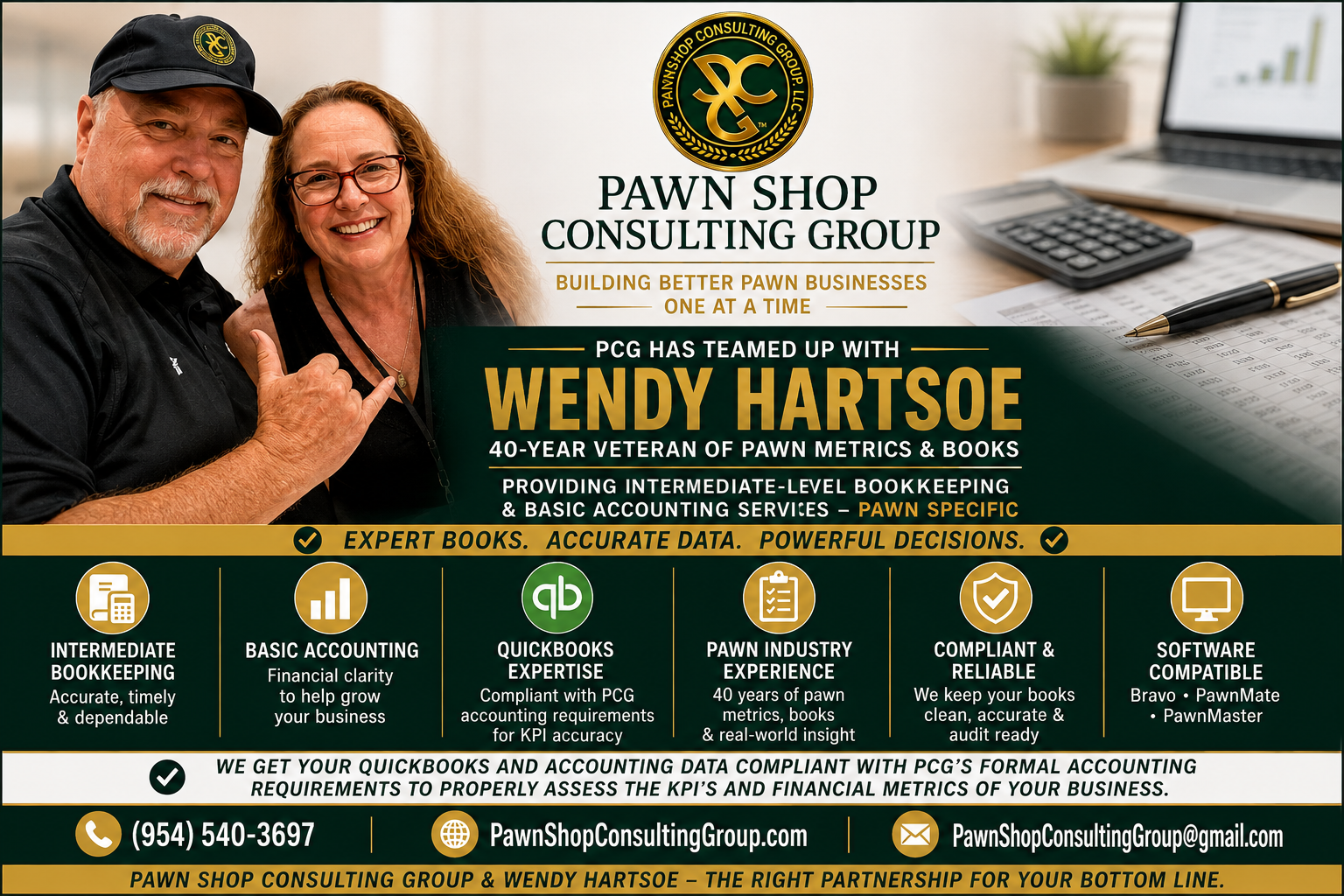
 Pawn Shop Consulting Group teams up with 40-year pawn industry veteran Wendy Hartsoe to provide pawn-specific bookkeeping and basic accounting services.
Pawn-Specific Bookkeeping & Accounting Services: PCG Teams Up With Industry Veteran Wendy Hartsoe
Better Books. Better Data. Better Decisions.
Pawn Shop Consulting Group is expanding its financial support services with pawnshop bookkeeping and basic accounting services specifically designed for independent pawn operators.
Experienced bookkeeping and basic accounting support from someone who actually understands the pawn business.
PCG has teamed up with Wendy Hartsoe, a highly experienced bookkeeping professional with approximately 40 years of hands-on experience working with pawnshop books, financial reporting and pawn-industry metrics.
That’s an important distinction.
There are plenty of good bookkeepers and accounting professionals in the marketplace.
But pawn isn’t a typical retail business.
Between pawn loans, service charges, inventory, forfeitures, layaways, retail sales, cost of goods, precious metals, multiple locations and the specialized operating systems used to track all of it, pawn accounting can become complicated very quickly for someone who doesn’t understand how a pawnshop actually operates.
Wendy does.
And PCG is now making that experience available to our clients.
Why Pawn-Specific Bookkeeping Matters
One of the first things Pawn Shop Consulting Group requests when conducting a comprehensive financial or operational analysis is good financial information.
We need timely and accurate:
- Profit & Loss Statements
- Balance Sheets
- General Ledger information
- Loan balances
- Inventory balances
- Revenue classifications
- Expense classifications
- Store-level financials
- Comparative-period reporting
- Other financial and operating data
Those reports become enormously valuable when they’re properly structured.
But there’s an old principle that applies particularly well here:
Bad data in means bad data out.
If the underlying books aren’t organized properly, accounts aren’t classified consistently, or data from the pawn operating system isn’t flowing correctly into the accounting system, even the most sophisticated financial analysis can begin with a flawed foundation.
Before PCG can accurately evaluate many of the Key Performance Indicators (KPIs) of a pawn operation, we need financial reporting that accurately represents what’s happening inside the business.
That’s where Wendy’s experience becomes particularly valuable.
Four Decades of Pawn Bookkeeping Experience
Wendy isn’t learning pawn accounting from a manual.
She has spent approximately four decades working with pawnshop books, pawn metrics and the financial information generated by pawn operations.
She understands the relationship between what happens across the pawn counter and what ultimately needs to appear on the financial statements.
That means understanding how operating activity eventually translates into:
revenue, expenses, assets, liabilities, inventory, loans, gross profit and ultimately net income.
That practical experience is difficult to replace.
A traditional bookkeeper may understand QuickBooks extremely well.
A pawn operator may understand pawn software extremely well.
The real value comes from understanding both sides of that equation—and how they need to communicate with each other.
QuickBooks Online and In-House Accounting Support
Wendy is experienced with QuickBooks Online, as well as in-house bookkeeping and accounting processes.
For many independent pawnshops, QuickBooks is where the company’s financial story ultimately comes together.
But QuickBooks is only as useful as the information being entered into it.
Accounts need to be properly structured.
Transactions need to be classified consistently.
Data needs to arrive on time.
Month-end reporting needs to be completed.
And most importantly, the accounting system needs to produce financial statements that an owner can actually use to manage the business.
PCG’s objective isn’t merely to make the books look tidy.
We want the books to tell us something.
Getting Your Pawnshop Chart of Accounts Right
One of the most important—and frequently overlooked—components of pawnshop accounting is the Chart of Accounts.
The Chart of Accounts determines how financial activity is categorized and ultimately reported.
If it isn’t designed appropriately for a pawn operation, critical information can become buried, combined or classified in ways that make meaningful analysis unnecessarily difficult.
A properly structured pawnshop Chart of Accounts should allow management and its advisors to clearly identify the major drivers of the business.
That can include areas such as:
- Pawn service charge and interest income
- Retail sales
- Cost of goods sold
- Inventory
- Pawn loan principal
- Layaway activity
- Precious-metal activity
- Payroll
- Advertising
- Occupancy
- Operating expenses
- Administrative expenses
- Store-level expenses
- Other income and expense categories
The objective is not to make accounting more complicated.
It’s exactly the opposite.
The objective is to create a financial structure that allows the owner to clearly see what is happening in the business.
Connecting Bravo, PawnMate and PawnMaster to Your Accounting
This is another area where specialized pawn experience matters.
Wendy is familiar with several of the major pawn operating platforms used throughout the industry, including:
PawnMate
PawnMaster
and other pawn management systems.
Those systems contain an enormous amount of valuable operational information.
But operational software and accounting software serve different purposes.
The challenge is making sure the appropriate information generated by the pawn system is being captured, reconciled, classified and properly incorporated into QuickBooks and the company’s financial reporting.
That’s not simply data entry.
It requires understanding what the numbers actually represent.
Your Pawn Software and QuickBooks Need to Tell the Same Story
This is where things can get interesting.
Your pawn software may say one thing.
Your QuickBooks may say something else.
Your bank account says something else.
And then somebody hands PCG a Profit & Loss Statement and asks:
“How are we doing?”
Before answering that question, we need confidence in the numbers.
That’s why reconciliation and consistency matter.
Loan balances should make sense.
Inventory should make sense.
Sales should make sense.
Cash activity should make sense.
Revenue classifications should make sense.
Balance Sheet accounts should reconcile.
And the financial reports should have a logical relationship with the operational reports being produced by the pawn management system.
When those systems don’t agree, we need to determine why.
Why Timely P&Ls and Balance Sheets Matter to PCG
PCG doesn’t request financial statements simply to put them into a client folder.
We use them.
A properly prepared Profit & Loss Statement allows us to evaluate revenue, gross profit, payroll, operating expenses, profitability and numerous other performance indicators.
A properly prepared Balance Sheet allows us to examine assets, liabilities, inventory, pawn loans, cash, equity and the overall financial position of the company.
Then we begin connecting that information with the operational metrics coming from the pawn software.
That’s where the picture becomes considerably more powerful.
We can begin examining:
Loan growth
Loan yield
Inventory levels
Inventory turns
Gross margins
Revenue productivity
Labor productivity
Expense ratios
Store-level profitability
Cash flow
Return on assets
and many other Key Performance Indicators.
But those calculations are only as reliable as the information behind them.
From Bookkeeping to Business Intelligence
This is ultimately what excites us about adding Wendy’s services to the PCG platform.
We’re creating a cleaner bridge between:
Daily pawn operations → Pawn software → Accounting → Financial statements → KPI analysis → Management decisions
Each step supports the next.
When those systems are properly organized, the owner gains something much more valuable than a completed set of books.
The owner gains visibility.
You can see where you’re making money.
You can see where you’re losing money.
You can identify expenses that are getting out of line.
You can compare one store against another.
You can compare this month against last month.
You can compare this year against last year.
You can identify trends before they become problems.
And you can make decisions based on facts instead of instinct alone.
Clean Books Are Also Important If and When You’re Ready to Sell
There is another significant benefit.
Eventually, many pawnshop owners will consider selling their businesses, acquiring another location, bringing in a partner, obtaining financing or completing a formal business valuation.
At that point, financial reporting becomes even more important.
A prospective buyer, lender, investor or valuation professional is going to want reliable financial statements.
If several years of books need to be reconstructed before anybody can understand the company’s true earnings, that creates unnecessary difficulty.
Clean, consistent financial reporting makes a business easier to understand.
And a business that’s easier to understand is generally easier to evaluate.
Good financial discipline isn’t something you begin when you’re ready to sell. It should be part of how you operate the business every month.
Not Every Pawnshop Needs a Full-Time Controller
This is another reason we believe this service fills an important need.
Many independent pawn operators don’t require—and may not be able to justify—the cost of a full-time controller or sophisticated internal accounting department.
But they still need good books.
They still need timely financial statements.
They still need somebody who understands how their pawn software relates to their accounting.
And they still need the financial information required to make intelligent management decisions.
PCG and Wendy can help fill that gap.
This is designed as intermediate-level bookkeeping and basic accounting support, specifically for pawn operators who need experienced assistance getting their financial house organized and keeping it that way.
When tax, audit, legal or higher-level CPA services are required, the appropriate outside professionals should still be involved.
We’re not trying to replace your CPA.
We’re trying to help make sure your CPA—and you—receive better information to work with.
PCG Financial Analysis Starts With Reliable Information
For more than two decades, Pawn Shop Consulting Group has worked with pawn operators to analyze performance, identify opportunities and improve profitability.
We routinely work through P&Ls, Balance Sheets, management dashboards, store reports and KPI data.
One recurring challenge has been receiving financial information that isn’t timely, isn’t organized consistently, or doesn’t properly reconcile with what we’re seeing in the pawn operating system.
Adding Wendy’s expertise gives us another way to address the problem at its source.
Rather than spending valuable consulting time trying to reconstruct what happened months later, we can help clients establish better financial reporting processes from the beginning.
That means PCG gets better information.
Management gets better information.
The owner gets better information.
And ultimately:
Better information creates better decisions.
Pawn-Specific Bookkeeping Is Now Available Through PCG
If your books are behind…
If your QuickBooks needs cleaning up…
If your Chart of Accounts doesn’t accurately reflect your pawn operation…
If your pawn software and accounting reports don’t seem to agree…
If you’re having difficulty producing timely monthly P&Ls and Balance Sheets…
Or if you simply want somebody with decades of pawn experience helping keep your financial reporting organized…
we should talk.
Pawn Shop Consulting Group and Wendy Hartsoe are now offering pawn-specific intermediate bookkeeping and basic accounting services designed around the actual needs of independent pawn operators.
Services can include:
QuickBooks Online support
Bookkeeping cleanup and organization
Chart of Accounts review and setup
Pawn software/accounting integration support
Monthly bookkeeping assistance
P&L and Balance Sheet preparation support
Financial data organization
Reconciliation assistance
Management reporting support
PCG financial-analysis preparation
Bravo, PawnMate and PawnMaster reporting assistance
Most importantly, you’ll be working with someone who understands that pawn accounting isn’t generic retail accounting.
Wendy understands pawn.
And she’ll be working alongside a consulting organization whose job is to turn those numbers into actionable business intelligence.
Ready to Get Your Books—and Your Business Intelligence—in Better Shape?
Contact Pawn Shop Consulting Group for a confidential discussion about our new pawn-specific bookkeeping and accounting support services with Wendy Hartsoe.
Pawn Shop Consulting Group, LLC
954-540-3697
pawnshopconsultinggroup@gmail.com
www.pawnshopconsultinggroup.com
Expert books. Accurate data. Powerful decisions.
Building better pawn businesses one at a time.
Put PCG Experience to Work
Have a question about your pawn business, financial performance, people, valuation or next strategic move?
REQUEST A CONSULTATION